(Brussels, February 4, 2026) – In the fourth year of its full-scale war against Ukraine, the Kremlin further escalated the crackdown on Russian civil society, targeting critics both inside the country and in exile, Human Rights Watch said today in its World Report 2026. Aiming to stifle all forms of dissent, authorities expanded censorship and surveillance, increasingly used “undermining state security” charges, and streamlined prosecutions of critics designated as “foreign agents.”
“Russian authorities scaled up repression against civil society activists and other critics. They also intensified their harmful ‘traditional values’ crusade that targets migrants, lesbian, gay, bisexual, and transgender people, and encroaches on women’s reproductive rights,” said Benjamin Ward, Europe and Central Asia acting director at Human Rights Watch.
In the 529-page World Report 2026, its 36th edition, Human Rights Watch reviews human rights practices in more than 100 countries. In his introductory essay, Executive Director Philippe Bolopion writes that breaking the authoritarian wave sweeping the world is the challenge of a generation. With the human rights system under unprecedented threat from the Trump administration and other global powers, Bolopion calls on rights-respecting democracies and civil society to build a strategic alliance to defend fundamental freedoms.
- Russia continued to attack Ukraine’s densely populated areas with explosive weapons, killing and injuring civilians and damaging vital infrastructure. Russian short-range drone strikes on Ukraine caused more civilian casualties than any other type of weapon. Russian authorities committed war crimes and crimes against humanity by systematically torturing and ill-treating thousands of Ukrainian prisoners of war and civilians. In occupied areas of Ukraine, Russian authorities continued to coerce residents into Russian citizenship and military service, seize private property, and impose Russian curricula and language in schools.
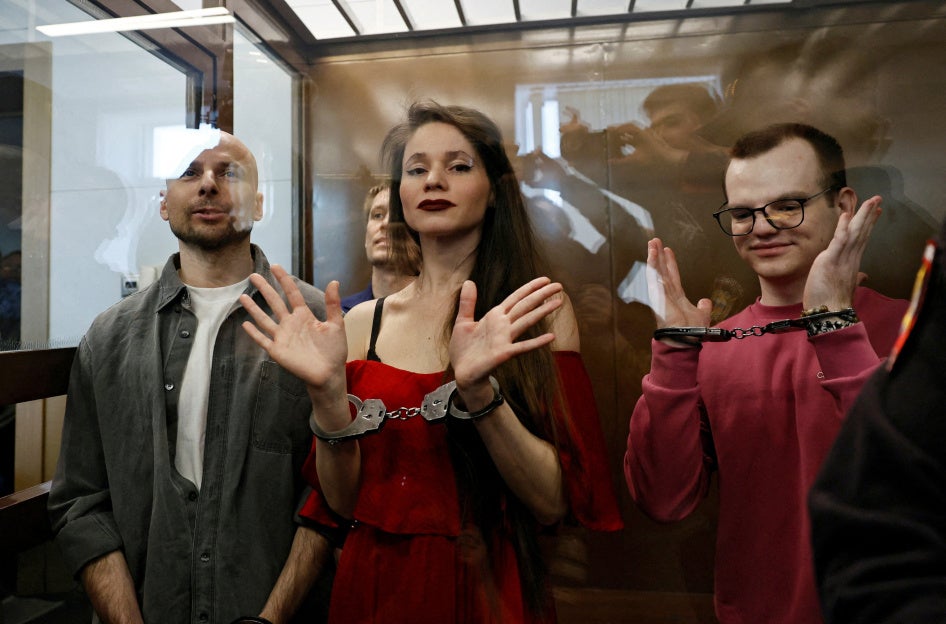
- The number of political prisoners rose to 1,217 (including 108 women), compared to 805 at the end of 2024.
- In 2025, courts imposed the first criminal sentences for supposed participation in the so-called International LGBT Movement, a designated “extremist organization.” Prosecutors also brought new “LGBT extremism” charges against people, including book publishers.
- Authorities sharply escalated criminal prosecutions over alleged noncompliance with “foreign agents” legislation, launching 72 criminal cases in the first half of 2025. Prosecutors also banned 78 organizations as “undesirable,” including prominent rights groups. In November, Human Rights Watch was designated “undesirable.” In May, a Moscow court sentenced leading Russian election monitoring activist Grigory Melkonyants to five years in prison over his supposed involvement with an “undesirable organization.”
- Authorities continued their assault on migrants’ rights. Law enforcement conducted raids, during which they subjected migrants to ill-treatment. In 2025, surveillance legislation on the “register of controlled persons” and an “experiment” to monitor labor migrants in Moscow and the Moscow region took effect. In April, a ban on enrolling foreign children in public schools without proof of legal status and Russian language proficiency took effect, creating a systemic, discriminatory barrier to children’s right to education. Eighty-seven percent of migrant children who applied were denied enrollment.
Russia should release all political prisoners and rescind all laws incompatible with fundamental human rights, including laws that censor criticism of the war and laws against so-called “foreign agents,” “undesirable” organizations, and “gay propaganda.” Russia should also rescind legislation that discriminates against migrants and their children, Human Rights Watch said.