(Bangkok) – Japan’s first woman prime minister, Sanae Takaichi, should promote new legislation prohibiting discrimination based on race, ethnicity, or religion, Human Rights Watch said today in its World Report 2026.
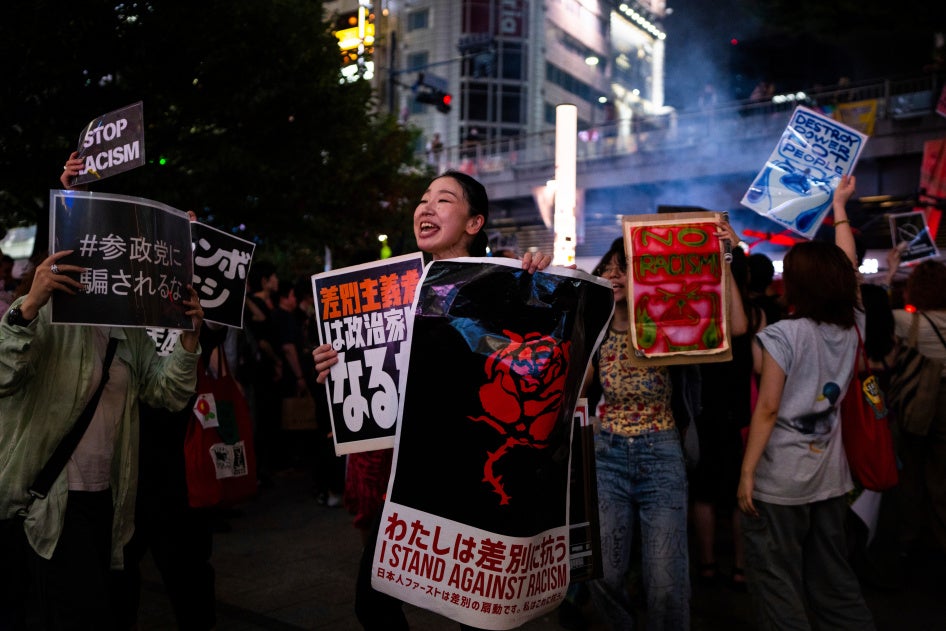
The unprecedented number of migrant workers living and working in Japan, along with record numbers of foreign tourists made immigration and xenophobia core themes of July’s upper house election. After becoming prime minister in October, Takaichi created a new cabinet post on issues involving foreign nationals in Japan.
“As Japan’s demographic changes, Prime Minister Takaichi should ensure that everyone’s rights are protected by passing an anti-discrimination law and creating an independent national human rights body,” said Kanae Doi, Japan director at Human Rights Watch. “The new government should also take on the leadership role that Japan should play in promoting human rights in the region and globally.”
In the 529-page World Report 2026, its 36th edition, Human Rights Watch reviews human rights practices in more than 100 countries. In his introductory essay, Executive Director Philippe Bolopion writes that breaking the authoritarian wave sweeping the world is the challenge of a generation. With the human rights system under unprecedented threat from the Trump administration and other global powers, Bolopion calls on rights-respecting democracies and civil society to build a strategic alliance to defend fundamental freedoms.
In addition to the lack of a general anti-discrimination law, Japan has no legislation prohibiting discrimination based on sexual orientation or gender identity, or age. Japan also does not have a national human rights institution. Japanese civil society groups have long urged the enactment of anti-discrimination laws as well as the establishment of an independent human rights institution.
The following were other key developments in Japan during 2025:
- Japan’s asylum and refugee determination system remains strongly oriented against granting refugee status. In 2024, the Justice Ministry received 12,373 applications for asylum but recognized only 190 people as refugees. The ministry also categorized 335 people as needing humanitarian assistance and 1,661 people were granted protection under Japan’s expanded refugee definition, allowing them to stay in Japan.
- In May, the Tokyo High Court issued a landmark ruling that the investigation and prosecutions in the Ohkawara Kakohki Co. case—a typical example of “hostage justice”—were illegal. Three individuals, including the company president, were wrongfully detained for nearly a year on false charges.
- In June, the Japanese National Diet revised the Basic Act on Sport, requiring national and local governments to adopt measures against physical, sexual, verbal, and other abuse. Child abuse, including corporal punishment, remains widespread in sports at all levels.
The Japanese government should address its weak systems for the protection of human rights by enacting comprehensive anti-discrimination laws and setting up a national human rights institution, Human Rights Watch said.