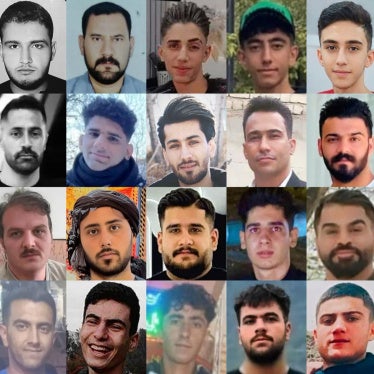
(Beirut) – Saudi authorities executed at least 356 people in 2025, setting a new record in the country for the highest number of executions in one year since monitoring began, Human Rights Watch said today. This is the second year in a row that Saudi authorities have set a new execution record, with 345 registered in 2024.
“The close of 2025 crystallized a horrifying trend in Saudi Arabia with a record surge in executions for the second consecutive year,” said Joey Shea, Saudi Arabia researcher at Human Rights Watch. “Governments should immediately press Crown Prince Mohammed bin Salman’s authorities to halt all executions.”
Executions of foreign nationals for nonlethal drug crimes drove the surge in executions in 2025. According to the nongovernmental organizations Reprieve and the European Saudi Organization for Human Rights (ESOHR), 240 of those executed had been convicted of nonlethal drug related offenses, and 188 of them were foreign nationals. Authorities executed 98 people in 2025 for charges solely related to hashish, according to the organizations.
Those executed included at least two men convicted of crimes allegedly committed as children. On October 20, the authorities executed Abdullah al-Derazi, who had been sentenced to death on terrorism charges related to participating in protests and funeral processions. Al-Derazi, 17 at the time of the alleged offenses in 2012, belonged to the country’s Shia Muslim minority, who have long experienced systematic discrimination and violence by the government.
On August 21, the authorities executed Jalal al-Labbad, who was 15 at the time of his alleged offenses. Saudi authorities arrested al-Labbad in 2017 for participating in demonstrations and funeral processions, the ESOHR reported. Both al-Derazi and al-Labbad were allegedly tortured by Saudi authorities while detained.
Several defendants accused of committing crimes as children remain at imminent risk of execution, including Yousef al-Manasif, Ali al-Mabiouq, Jawad Qureiris, Ali al-Subaiti, Hassan al-Faraj, and Mahdi al-Mohsen, Human Rights Watch said.
On June 14, Saudi authorities executed Turki al-Jasser, a journalist known for exposing corruption within the Saudi royal family, raising concerns that the Saudi government is using the death penalty to crush peaceful dissent.
International human rights law, including the Arab Charter on Human Rights, ratified by Saudi Arabia, obligates countries that use the death penalty to only do so for the “most serious crimes” and in exceptional circumstances. The Office of the United Nations High Commissioner for Human Rights released a statement in November 2022 about the alarming rate of executions in Saudi Arabia after it ended a 21-month unofficial moratorium on the use of the death penalty for drug-related offenses.
Human Rights Watch opposes capital punishment in all countries and in all circumstances as a matter of principle because this form of punishment is inhumane, unique in its cruelty and irreversibility, and universally plagued with arbitrariness, prejudice, and error. International law, including the Convention on the Rights of the Child, to which Saudi Arabia is a party, includes an absolute prohibition on capital punishment for crimes committed by children.
“Celebrities, athletes, and others seeking to cash in on Saudi whitewashing of its human rights record should reconsider based on the number of executions during 2025 to determine whether the money is worth being associated with this killing spree,” Shea said.